
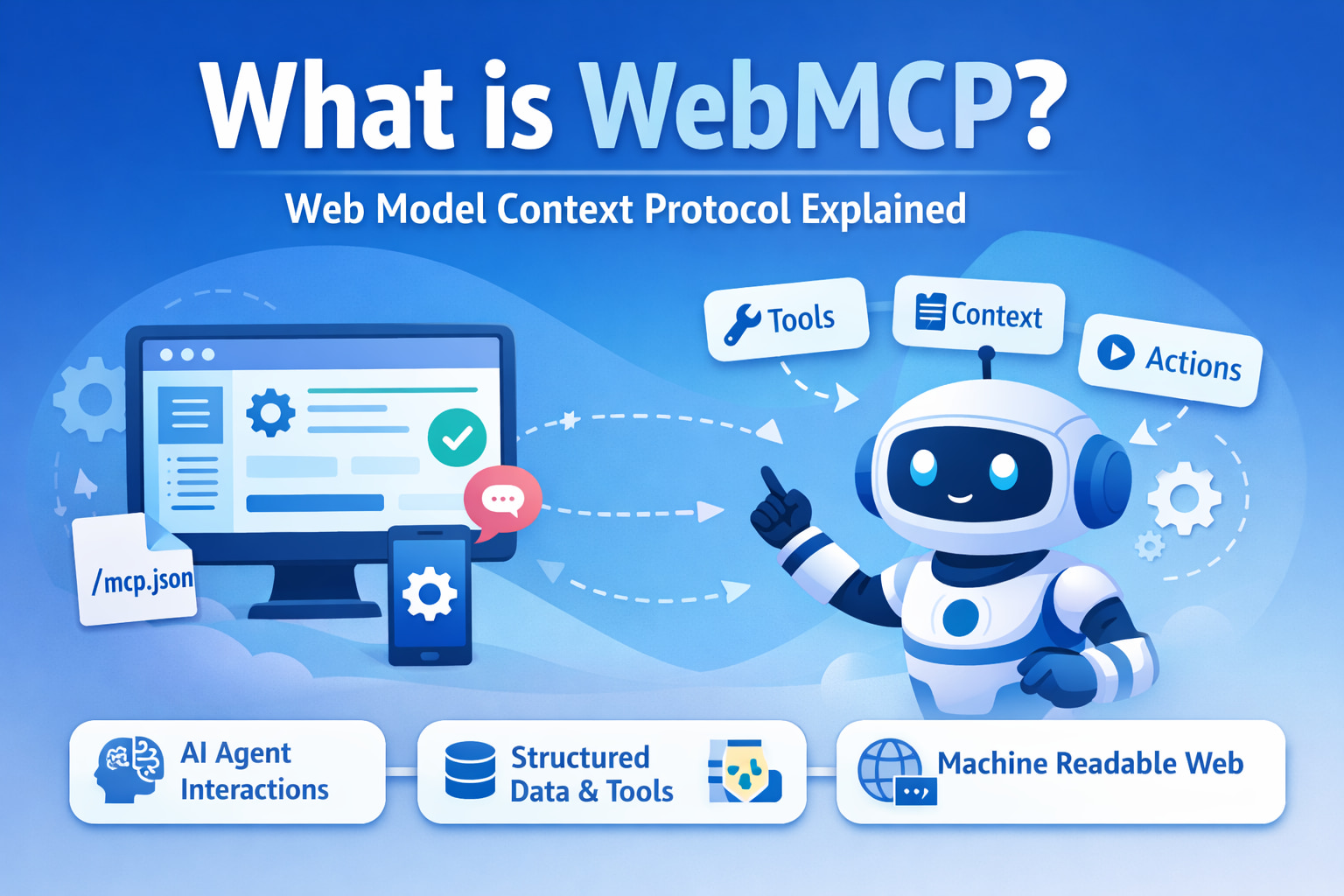
WebMCP is emerging as a useful way for websites to expose structured tools and context to AI agents. Here is a simple explanation of what it is, why it matters, and how to check whether a site supports it.
What is WebMCP
At a simple level, WebMCP is a way for websites to expose structured tools, actions, and context so AI systems can interact with them more intelligently.
Instead of forcing an AI agent to infer meaning from HTML alone, WebMCP-style implementations can provide stronger signals about what the website can do, what actions are supported, and what context should be shared.
This matters because AI interaction with the web is moving beyond summarization and search. Agents are beginning to browse, trigger actions, analyze results, and complete workflows. For those use cases, a more machine-readable web layer becomes useful.
Why does WebMCP matter?
The more AI agents interact with websites, the more fragile pure scraping becomes.
Scraping often falters due to:
- shifts in user interface design,
- alterations in button text,
- changes in layout,
- or the failure of hidden assumptions.
A well-defined model for actions and context can significantly improve the stability, clarity, and overall utility of AI interactions.
In that sense, WebMCP matters because it can help websites become easier for AI systems to work with in a more reliable way.What can WebMCP enable?WebMCP-related implementations can potentially support:
- Better AI tool discovery on websites
- Clearer machine-readable actions
- Richer context sharing
- More reliable automation
- Less dependence on brittle scraping patterns
How do you check whether a site supports WebMCP?That is exactly why I built the WebMCP Checker.The tool scans a public website for detectable WebMCP-related signals such as:
- Scripts
- Model Context Patterns
- Tool Registration Markers
- Well-known files like /.well-known/mcp.json
It then assigns a level and confidence score based on the evidence found.You can try it here:
What does a 0% result mean?
A 0% result means no public WebMCP-related signals were found.That does not always prove the site has no WebMCP support at all. Some implementations may be runtime-based or not publicly detectable through a lightweight scanner.Still, a 0% result usually means there is no obvious public support exposed at the time of checking.
Why this matters for WordPress
WordPress powers a large portion of the web. As AI agents become more useful, WordPress sites also need structured ways to expose actions and content.That is one reason I am also building the WP WebMCP Layer:
https://github.com/kulkarnitech/WP-WebMCP↗
Final thought
WebMCP is worth paying attention to because it points toward a more structured web for AI interaction.If AI agents are going to browse, interpret, and act on websites more often, then websites will need better ways to communicate capabilities.That is the gap WebMCP is trying to address.
If you want to test live websites, use the checker here:
https://webmcpchecker.com ↗
